
Wicked is a big win for Hollywood musicals and an undeniable triumph for the genre’s cinematic resurgence. It’s also, for better or worse, a cultural boon for the most “passionate” breed of theater enthusiasts—those theater kids whose fervor can make even the most patient moviegoer wince. Still, setting aside the raucous sing-alongs and unsolicited commentary, the film’s sheer spectacle and emotional depth make it well worth enduring the chatter.
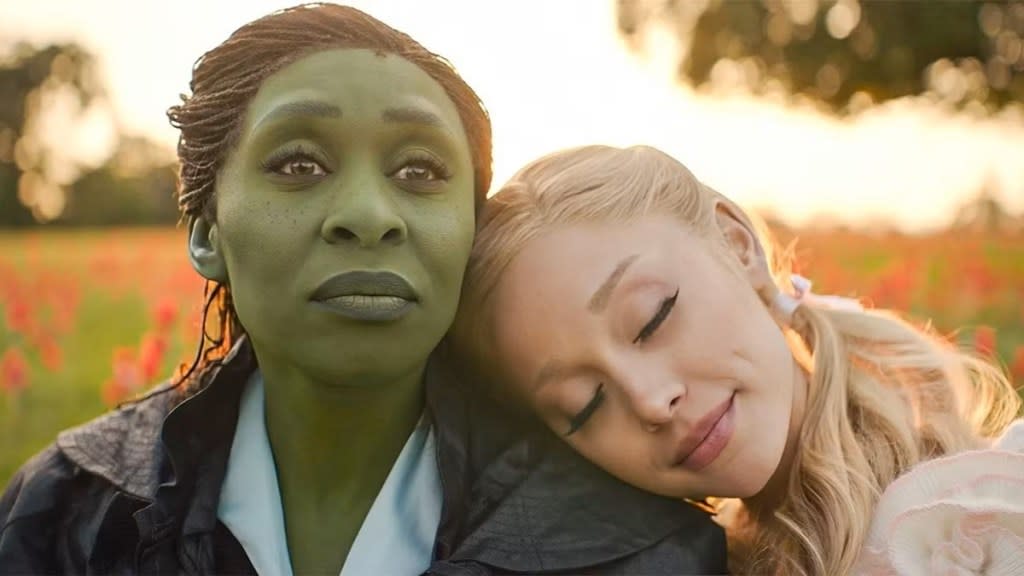
At the heart of the film’s success are the powerhouse performances of Ariana Grande and Cynthia Erivo. Grande’s portrayal of Glinda is a revelation. While many expected charm and glamour, her “Legally Blonde”-inspired take on the character adds a layer of comedic brilliance. She captures Glinda’s social ambition, self-absorption, and eventual self-awareness with infectious charm, striking a delicate balance between satire and sincerity. Her performance of “Popular” is a showstopper, blending humor, warmth, and a subtle tinge of sadness that hints at the complexity beneath Glinda’s bubbly exterior.
Meanwhile, Cynthia Erivo’s portrayal of Elphaba is nothing short of transcendent. Her reserved, mature approach to the role lends Elphaba a quiet intensity that builds with each passing scene. Erivo’s performance of “Defying Gravity” is the film’s emotional apex—an electrifying, goosebump-inducing moment that captures Elphaba’s shift from misunderstood outcast to empowered force of nature. While I’ve tried (and failed) to replicate the war chant from that iconic number, Erivo’s raw power and emotional restraint make it clear that no imitation could do it justice. Her Elphaba is a study in control—quiet rage simmering under calm resolve—until it all explodes in a soaring, defiant climax.
If there’s one casting misstep, it’s Jeff Goldblum as the Wizard. On paper, it’s a brilliant choice—his quirky charm and unpredictable energy seemed tailor-made for the role. But in practice, Goldblum’s performance comes across as surprisingly subdued. He seems tired, distracted, as if he’s mentally elsewhere for much of his screen time. Instead of embodying the Wizard’s grandeur or menace, he’s strangely flat, offering a performance that’s more “curious old man” than “master manipulator.” It’s one of the rare misfires in a film otherwise teeming with inspired casting choices.
At its core, Wicked explores profound themes of power, prejudice, and identity. As a prequel to The Wizard of Oz, it turns the familiar story on its head, shifting focus to the relationship between Elphaba (the Wicked Witch of the West) and Glinda (the Good Witch of the North). Through the prism of their friendship, the film unravels how societal judgment and prejudice shape people’s identities. Elphaba, born with extraordinary gifts and an unshakable moral compass, is marked as “wicked” not because of her actions but because of her appearance and her defiance of the status quo. She’s a woman of principles in a world that fears principled women. Glinda, on the other hand, is adored for her beauty and charm, but she’s also complicit in maintaining the oppressive system that deems Elphaba a villain.
The story’s deeper critique lies in its examination of how society creates villains and heroes. Heroes, like Glinda, are often crowned not for their actions but for their appearance and compliance with social norms. Villains, like Elphaba, are cast aside for daring to be different. The musical’s exploration of “good” versus “wicked” unpacks the dangers of binary thinking. It’s a pointed reminder that morality is rarely black and white—it’s nuanced, messy, and deeply human. The film’s visual cues reinforce these themes, with Glinda bathed in soft, golden hues and Elphaba surrounded by deep, shadowy greens. These symbolic choices highlight the way perception is shaped by aesthetic narratives and how “goodness” is often just a matter of presentation.
Wicked is not just a feast for the eyes and ears—it’s a mirror held up to the world we live in. It asks us to reconsider who we’ve deemed heroes and villains in our own lives. Who have we dismissed because they don’t fit the mold of who we think “good” people should be? Who have we idolized without questioning the harm they’ve caused? Through Elphaba and Glinda’s story, the film challenges these assumptions and urges audiences to look beyond the surface. It’s an ambitious undertaking for a blockbuster musical, but thanks to the monumental performances of Grande and Erivo, it’s one that lands with force.
For all its magic and spectacle, Wicked is, at its heart, a story about empathy—about seeing people for who they are rather than who society tells us they must be. And that, perhaps, is its most enduring spell of all.

 newjerseyinstituteoffilm.com